
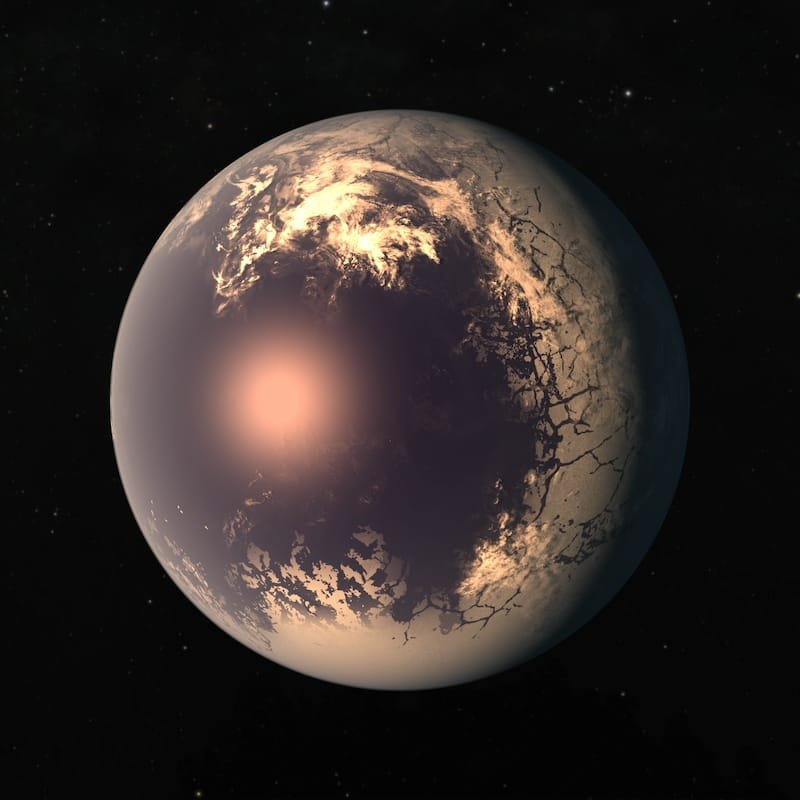
Introduction: Why LHS 1140 b Has Attracted Scientists
LHS 1140 b is an exoplanet orbiting a small red-dwarf star roughly 48–49 light-years from Earth in the constellation Cetus. It first attracted attention in 2017 because it is relatively close to our Solar System, passes in front of its star from our viewpoint, and receives an amount of starlight that places it in the star’s habitable zone.
Since its discovery, however, scientists have learned that LHS 1140 b is more complicated than the original picture suggested. Updated measurements of its mass and radius indicate that it may not be a straightforward rocky planet like Earth. Instead, researchers have considered possibilities ranging from a small hydrogen-rich mini-Neptune to a water-rich world containing a large amount of water by mass.
Observations made with the James Webb Space Telescope (JWST) in 2024 made the water-world possibility especially interesting. At the same time, research published in 2026 has produced a new mystery involving helium in the upper atmosphere. One study reported escaping helium, while several subsequent JWST analyses did not detect it. The result is a planet that is scientifically exciting precisely because many of its most important properties are still uncertain.
What Is LHS 1140 b?
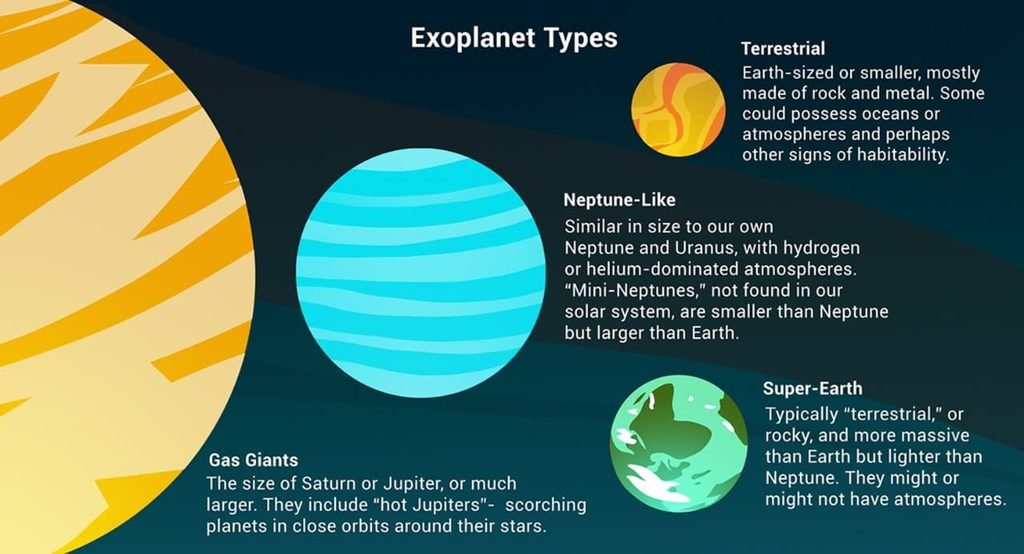
LHS 1140 b is an exoplanet, meaning a planet outside our Solar System. NASA classifies it as a super-Earth, a term generally used for planets larger or more massive than Earth but smaller than Neptune. The label describes its size category; it does not automatically mean that the planet has an Earth-like surface or environment.
The planet was discovered in 2017 using the transit method. When LHS 1140 b passes in front of its star, it blocks a tiny amount of starlight. By repeatedly measuring that change in brightness, astronomers can determine the planet’s size and orbit. Other observations, including measurements of the star’s motion caused by the planet’s gravity, help determine its mass.
Those measurements are important because a planet’s mass and radius together provide clues about its average density and possible internal structure.
Where Is LHS 1140 b Located?
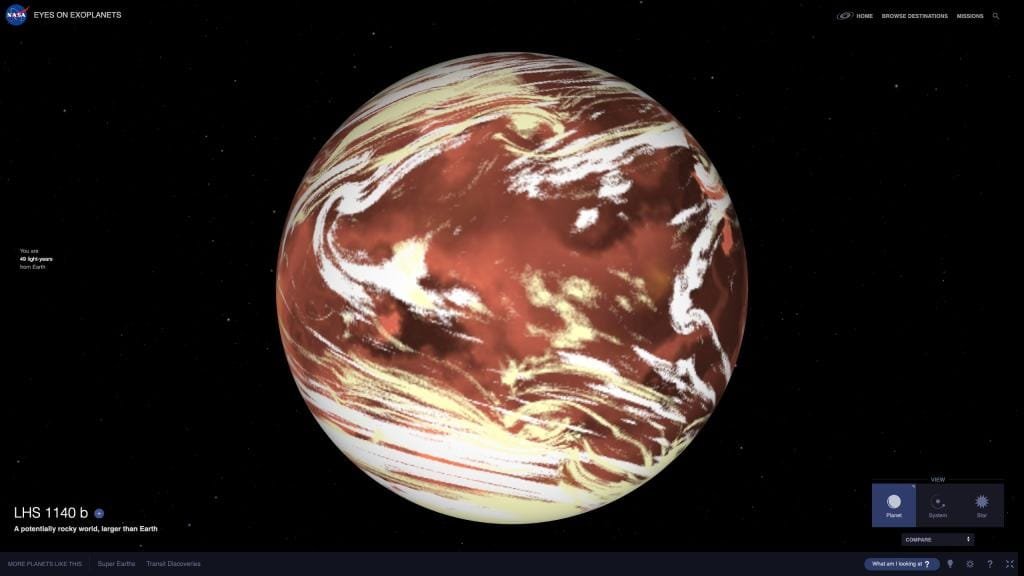
LHS 1140 b orbits the star LHS 1140, an M-type red dwarf in the constellation Cetus. The system is relatively nearby on the astronomical scale, at roughly 48–49 light-years from Earth.
That distance is enormous by human standards, but comparatively small when astronomers study exoplanets. LHS 1140 is also much smaller, cooler, and dimmer than our Sun. Because the star produces much less energy than the Sun, a planet does not need to orbit very far away to receive moderate amounts of heat.
LHS 1140 b orbits only about 0.095 astronomical units (AU) from its star. One AU is the average distance between Earth and the Sun, so the planet’s orbit is far closer to its star than Earth’s orbit is to the Sun.
LHS 1140 b: Key Facts and Numbers
- Property: LHS 1140 b
- Planet type: Super-Earth
- Discovery: 2017
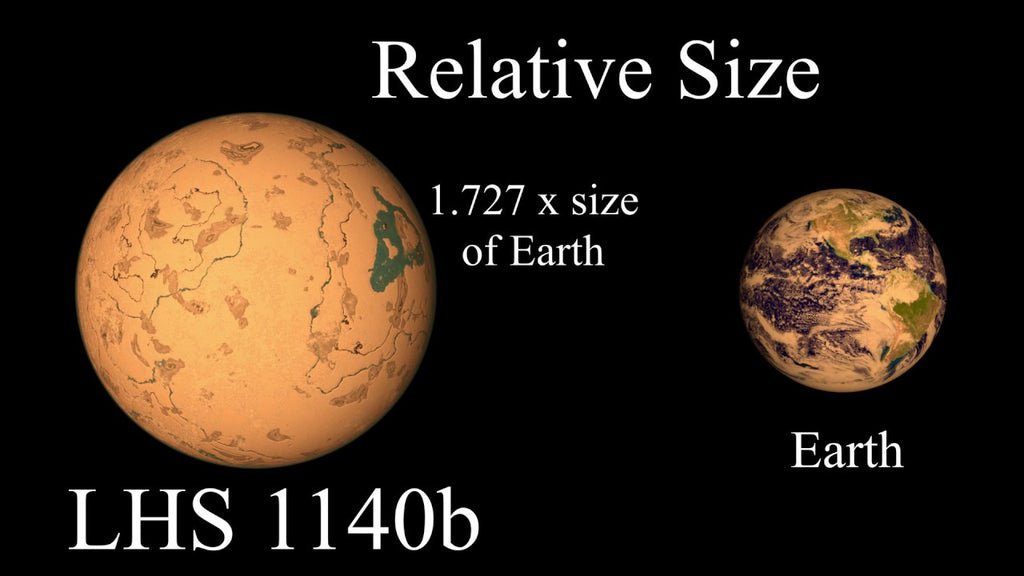
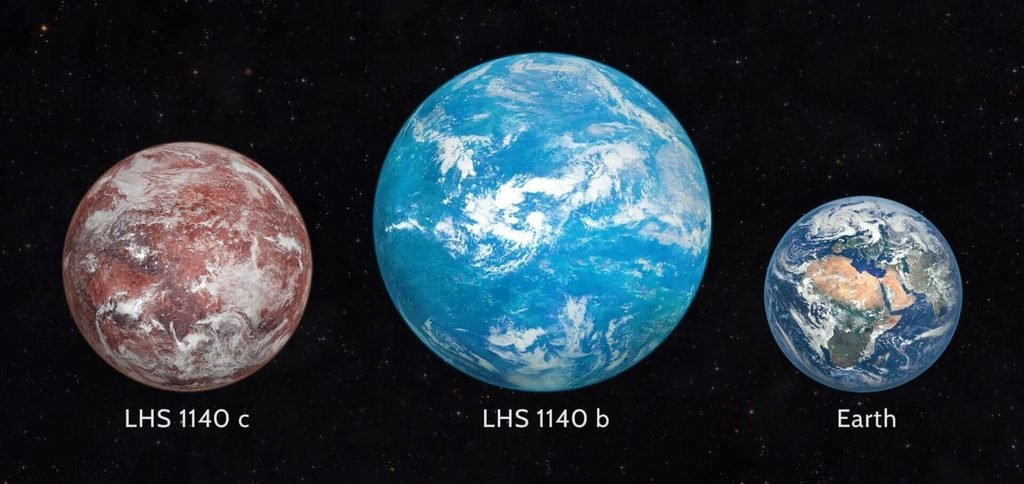
- Radius: About 1.73 times Earth’s
- Mass: About 5.6 times Earth’s
- Orbital period: About 24.7 Earth days
- Orbital distance: About 0.095 AU
- Host star: LHS 1140, an M-type red dwarf
- Equilibrium temperature: About 226 K
- Distance from Earth: Roughly 48–49 light-years
- NASA’s current catalog lists a radius of about 1.73 Earth radii, a mass of about 5.6 Earth masses, an orbital period of 24.7 days, and an orbital distance near 0.095 AU.
Its estimated equilibrium temperature is around 226 K, although this should not be confused with the actual surface temperature. Equilibrium temperature is a simplified calculation that depends on how much energy the planet receives and assumptions about how it reflects and redistributes that energy. A real atmosphere can substantially change surface conditions.
The Star LHS 1140: A Small Red-Dwarf Sun
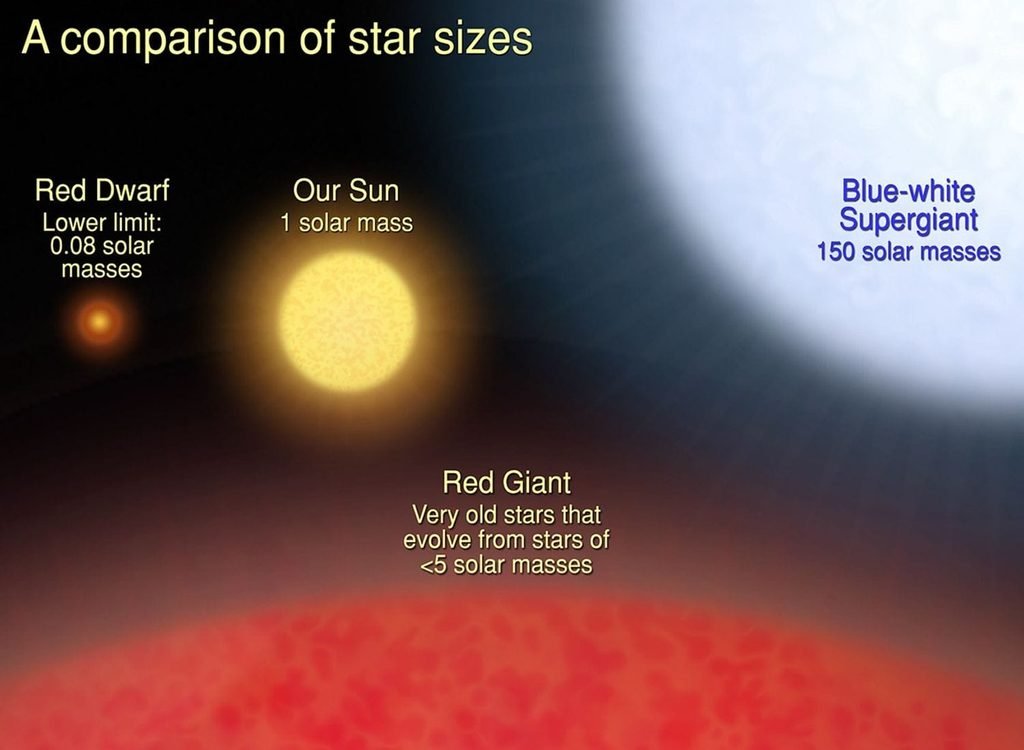
LHS 1140 is an M4.5-type red dwarf, a category of star that is much cooler and less luminous than the Sun. Current stellar measurements place its mass at roughly one-fifth of the Sun’s mass, with a radius also far smaller than the Sun’s.
This matters because a planet’s climate depends heavily on its star.For Earth, the Sun supplies enormous amounts of energy from a distance of about 150 million kilometers. LHS 1140 b can receive moderate levels of energy while orbiting much closer because its star is so faint.
Red dwarfs are also important in exoplanet research because they are small. When a planet crosses a small star, the planet blocks a larger fraction of the star’s light than it would if it crossed a Sun-sized star. This can make the planet’s atmosphere easier to study using telescopes.
Is LHS 1140 b in the Habitable Zone?
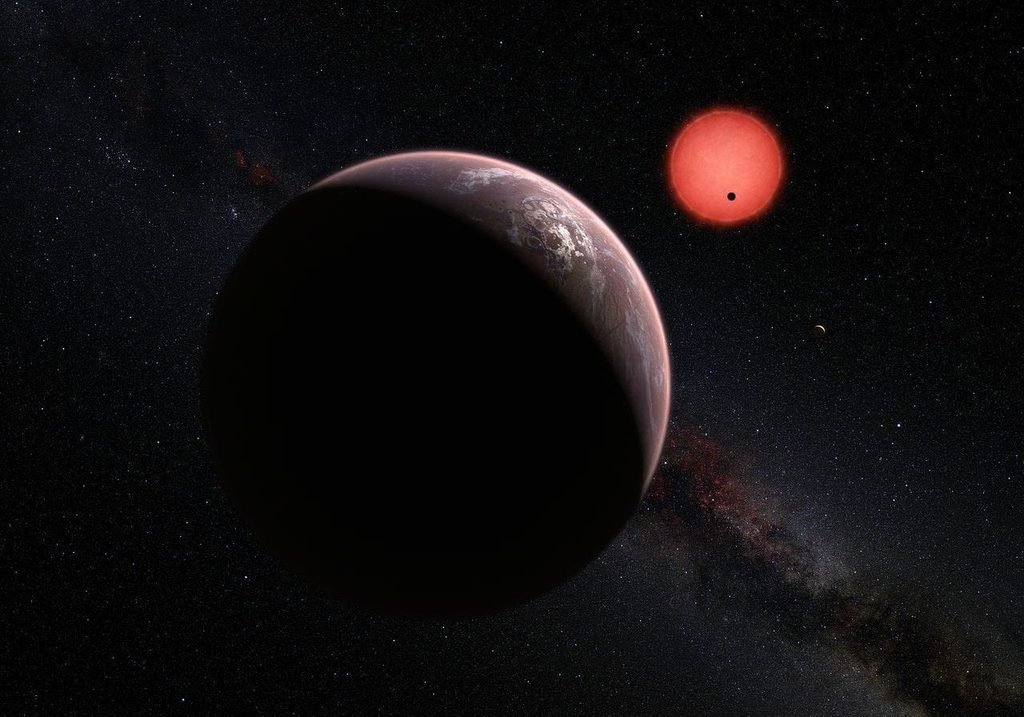
Yes. LHS 1140 b orbits within the habitable zone, sometimes called the “Goldilocks zone,” of its star. This is the region around a star where, under suitable atmospheric conditions, temperatures could allow liquid water to exist on a planet’s surface.
But there is a crucial point:
- Being in the habitable zone does not mean that a planet is habitable.
- A planet could be in the right orbital region but have no atmosphere, an atmosphere that is too thick, the wrong chemical composition, extreme temperatures, or no stable surface liquid water.
- Earth’s habitability results from a combination of factors, including its atmosphere, surface, temperature, water cycle, chemistry, and long-term climate stability. Scientists therefore treat the habitable zone as a starting point rather than a guarantee.
- NASA has identified LHS 1140 b as one of the relatively small potentially habitable worlds that can be studied with Webb, although detecting atmospheric gases on such planets remains extremely difficult.
A Rocky Super-Earth or a Water World?
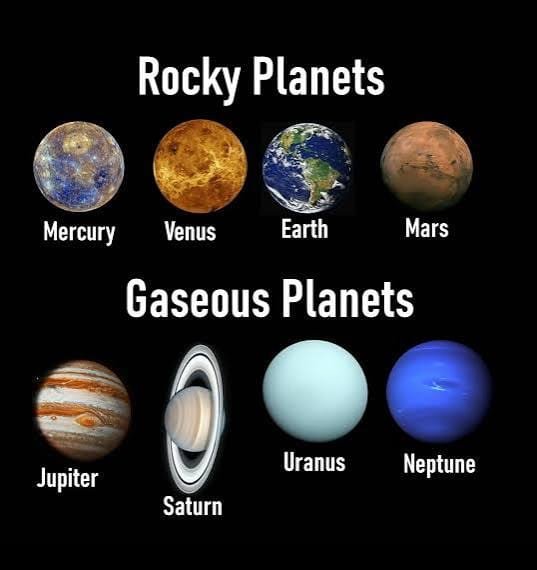
This is one of the biggest questions surrounding LHS 1140 b.The planet’s updated mass is about 5.6 times Earth’s, while its radius is about 1.73 times Earth’s. Those measurements give it a relatively low density for a planet that was once thought to be a straightforward rocky super-Earth.
Researchers have proposed two major possibilities.
- The first is a mini-Neptune-like planet with a relatively small hydrogen and helium envelope surrounding a denser interior.
- The second is a water-rich planet, sometimes described as a water world. Interior models have suggested that roughly 9–19% of the planet’s mass could be water, depending on assumptions about its composition and atmosphere.
These are models rather than direct measurements of the planet’s interior. Astronomers cannot currently look through the planet and determine exactly how much water it contains.That is why atmospheric observations are so important.
Could LHS 1140 b Have a Huge Ocean?
The idea of an ocean world is scientifically plausible, but a global ocean has not been confirmed.
The 2024 JWST study led by Mario Damiano and colleagues found that the observed transmission spectrum was difficult to reconcile with a hydrogen-rich atmosphere. Their models instead favored a heavier atmosphere, potentially dominated by nitrogen with water vapor and carbon dioxide. The researchers argued that, under the right climate conditions, such an atmosphere could allow liquid-water oceans.
Another 2024 JWST study by Charles Cadieux and colleagues similarly found tentative evidence consistent with a high-molecular-weight atmosphere and reported that hydrogen-rich atmospheric scenarios were strongly disfavored in their models. Their analysis suggested that LHS 1140 b could be either airless or surrounded by an atmosphere with heavier molecules, with an N2-rich atmosphere being one possibility.
It is important not to turn these results into a stronger claim than the evidence allows.
Scientists have not photographed an ocean on LHS 1140 b. They have inferred possible interior and atmospheric states from observations and computer models.
What Does the James Webb Space Telescope Tell Us?

The James Webb Space Telescope is particularly valuable for studying LHS 1140 b because it can measure infrared light over wavelengths where atmospheric molecules can leave detectable signatures.
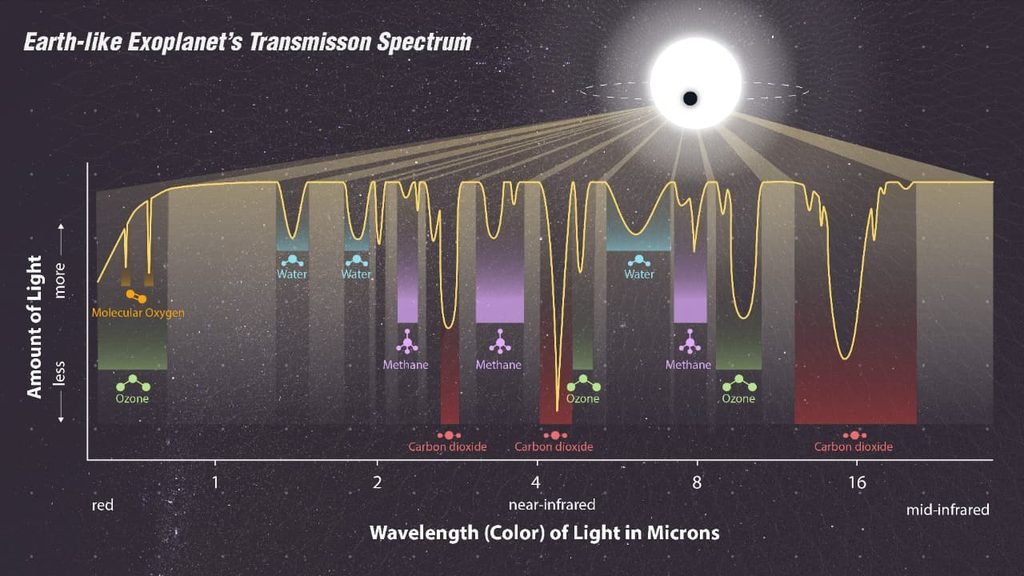
During a transit, the planet passes between its star and Earth. Most of the star’s light travels directly toward us, but a small fraction passes through the planet’s atmosphere. Different gases absorb different wavelengths of light. By analyzing these changes, astronomers can estimate which molecules may be present. This technique is called transmission spectroscopy.
The challenge is that the signal from a small planet’s atmosphere is extremely weak. Even detecting an atmosphere around a potentially habitable small planet can require repeated observations and careful correction for changes in the star itself.
For LHS 1140 b, JWST has already provided some of the most important evidence about what kind of world it might be.
What Scientists Learned About Its Atmosphere

Two important JWST studies published in 2024 reached related but not identical conclusions.
The NIRSpec study examined wavelengths from about 1.7 to 5.2 micrometers. It found that the observed spectrum was inconsistent with several hydrogen-rich atmosphere models. Instead, the data favored a high-mean-molecular-weight atmosphere, potentially dominated by nitrogen with water and carbon dioxide. The authors described the evidence as having modest confidence, meaning it was promising but not definitive.
The NIRISS study analyzed two JWST transit observations. It found a stellar surface effect known as faculae and reported tentative evidence, at about 2.3 sigma, for spectral features consistent with Rayleigh scattering from an N2-dominated atmosphere. Its climate models strongly disfavored a wide range of hydrogen-rich atmospheres.
These findings are interesting because a nitrogen-rich atmosphere is much heavier than a hydrogen-dominated one. A heavier atmosphere would make it easier for the planet to retain gases over long periods and could fit a scenario in which LHS 1140 b is water-rich.
But neither study proves that the atmosphere is definitely nitrogen-dominated.The observations are still being interpreted, and future JWST measurements are needed.
New JWST Results in 2026: The Mystery of Helium

The story became even more complicated in 2026.
In July, a Science paper reported a detection of helium escaping from the upper atmosphere of LHS 1140 b using the WINERED spectrograph on the Magellan Clay Telescope. The researchers interpreted the signal as evidence that the planet has retained an atmosphere and is losing helium from its upper layers.That result was important because detecting escaping atmospheric gas can provide evidence that an atmosphere exists.
However, the story did not end there.
In August 2026, researchers analyzed four JWST/NIRISS transit observations of LHS 1140 b obtained between 2023 and 2026. They reported no helium absorption in any of the four observations and rejected the previously reported helium signal at more than 3 sigma in each visit.
A separate analysis of the same JWST observations likewise found no evidence of persistent helium absorption. That study reported that the star itself showed helium-line variability and suggested that stellar or observational effects could contribute to the earlier ground-based result. It also noted that intermittent atmospheric escape cannot be completely excluded because the JWST observations were not simultaneous with the original detection.
This does not mean the earlier Science result has simply been proved wrong. Instead, it means the helium story is currently unsettled.
The disagreement is scientifically valuable: astronomers now have a clear test that can be repeated with additional observations.
Could LHS 1140 b Support Life?
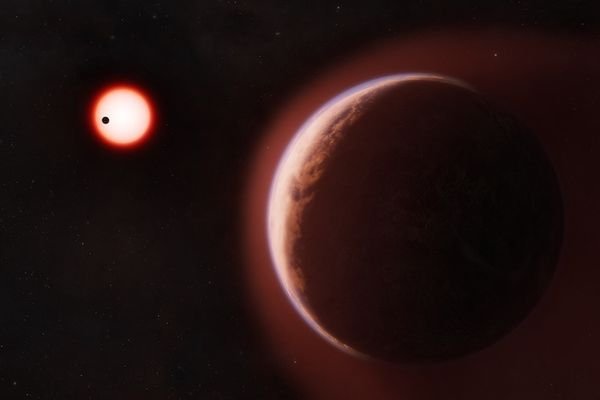
At present, there is no evidence that LHS 1140 b contains life.
- For a planet to be potentially habitable, scientists would first need to establish that it has a stable environment where liquid water could exist for long periods. They would then need to understand its atmosphere, climate, chemistry, radiation environment, and geological history.
- The possible water-world scenario is interesting because liquid water is an important ingredient for life as we understand it. But water alone is not enough.
- There is another complication: scientists are still trying to determine whether LHS 1140 b is genuinely rocky, water-rich, or a mini-Neptune with a thin hydrogen-rich envelope.
- So it is better to describe LHS 1140 b as a potentially habitable world and an important target for atmospheric study, rather than as a planet known to support life.
LHS 1140 b Is Not Proof of Alien Life
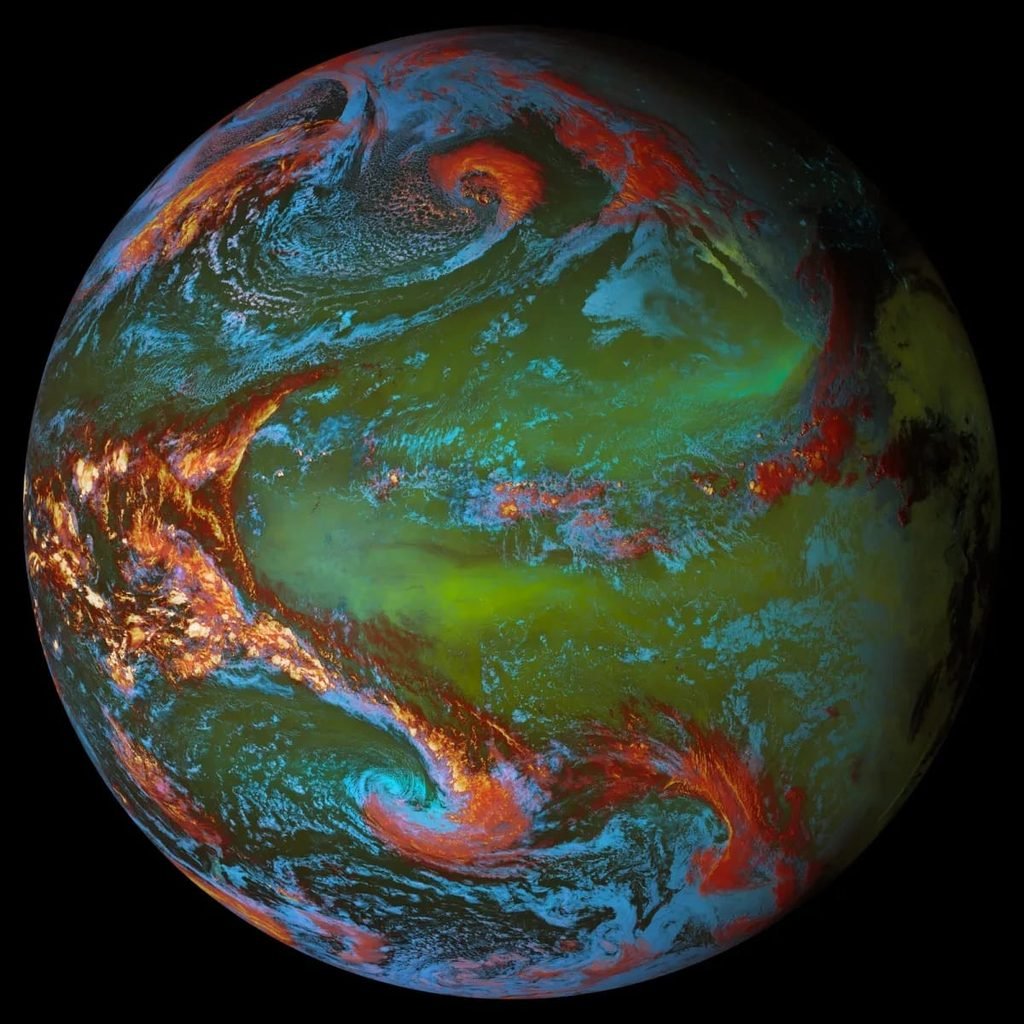
Headlines about planets in habitable zones can easily create the impression that astronomers have discovered another Earth.
That is not what has happened here.
- No telescope has detected organisms, vegetation, cities, or any confirmed biological activity on LHS 1140 b. There is also no confirmed detection of an Earth-like atmosphere or a confirmed global ocean.
- Even a future discovery of water vapor would not automatically prove life. Water is common throughout the universe, and many non-biological processes can produce atmospheric gases.
- Scientists instead look for combinations of evidence that cannot easily be explained by ordinary geology or chemistry. Such searches are extremely difficult, especially for small planets around distant stars.
- LHS 1140 b is valuable because it may eventually allow scientists to study the atmospheric conditions of a relatively nearby, temperate world in much greater detail.
How Scientists Study a Planet So Far Away
Astronomers cannot send a spacecraft to LHS 1140 b with today’s technology. Instead, they study it indirectly.
- The transit method measures the tiny dip in starlight as the planet crosses its star. This helps determine the planet’s radius and orbital period.
- Radial-velocity measurements detect the small motion of the star caused by the planet’s gravitational pull. These observations help determine the planet’s mass. Combining mass and radius gives an estimate of its average density.
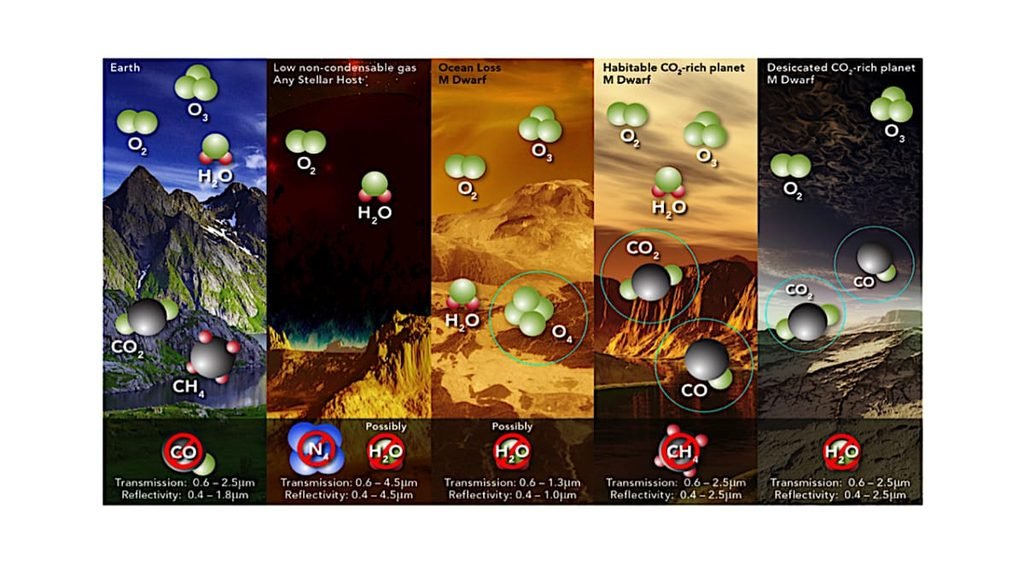
- Transmission spectroscopy goes one step further. When the planet passes in front of its star, some starlight travels through its atmosphere. Molecules such as water, carbon dioxide, methane, or other gases can absorb particular wavelengths.
- Astronomers then compare the observed spectrum with computer models of different atmospheres. Instead of seeing an ocean directly, they test which combinations of atmosphere, surface, clouds, and internal composition are consistent with the data.
This is why exoplanet science often works more like solving a puzzle than taking a conventional photograph.
What We Still Don’t Know About LHS 1140 b
Despite years of observations, several major questions remain unanswered.
- The first is the planet’s true composition. Current measurements allow more than one internal structure.
- The second is the atmosphere. Evidence from 2024 points toward the possibility of a heavier atmosphere, potentially rich in nitrogen, but the observations are not yet enough to provide a complete chemical inventory.
- The third is the planet’s surface. Scientists do not know whether it has continents, a global ocean, an ice-covered surface, or another configuration.
- The fourth is atmospheric stability. The conflicting helium observations in 2026 show how difficult it can be to determine whether atmospheric gases are steadily escaping or whether unusual events occur only occasionally.
These uncertainties are not failures of astronomy. They are exactly the kinds of questions that new observations are designed to answer.
What Future Observations Could Reveal

Future observations could help distinguish among the leading scenarios.
- Repeated JWST transit observations could improve constraints on molecules such as carbon dioxide, water vapor, and other atmospheric components. Because individual measurements are extremely small, combining multiple observations can make weak patterns easier to identify.
- Additional high-resolution observations could also test the conflicting helium results. Observing the planet and its host star during the same events would help researchers separate possible planetary signals from changes occurring on the star itself.
- Scientists also need better measurements of the planet’s mass, radius, and atmospheric behavior. Together, those measurements could reveal whether LHS 1140 b is more consistent with a water-rich planet, a mini-Neptune, or another structure.
- Over time, the goal is not simply to answer “Does it have water?” but to build a complete picture of how the planet formed, how its atmosphere evolved, and whether its surface could remain stable enough for potentially habitable conditions.
Why LHS 1140 b Matters to the Search for Habitable Worlds
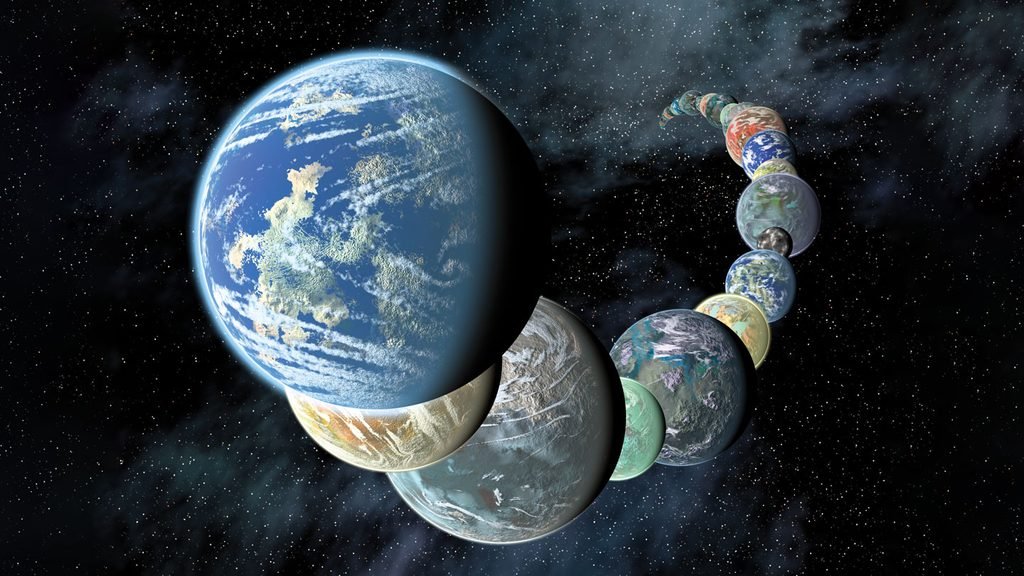
LHS 1140 b matters because it sits at an important intersection of exoplanet science.
It is relatively nearby. It is large enough to produce measurable signals. It passes in front of its star. Its orbit lies in the star’s habitable zone. And its atmosphere, if present, may be accessible to powerful telescopes.
More importantly, it represents a broader scientific question: How common are worlds that can keep atmospheres and potentially maintain liquid water?
Earth is the only planet currently known to support life. Studying other worlds does not just help us search for life elsewhere; it also helps scientists understand how planets evolve and why Earth developed the conditions it did.
LHS 1140 b may therefore become an important case study in understanding the boundary between rocky planets, water-rich planets, and small worlds with thick atmospheres.
Conclusion: A Mysterious World in the Habitable Zone

LHS 1140 b is not a confirmed second Earth, and scientists have not discovered life or a global ocean there.
What makes it remarkable is the uncertainty.
Its size and mass place it in a difficult region between familiar categories of planets. Its location around a cool red dwarf puts it in the star’s habitable zone. JWST observations have provided intriguing evidence that its atmosphere could be heavier and potentially nitrogen-rich, strengthening interest in the possibility of a water-rich world.
Then came the 2026 helium debate. A Science study reported escaping helium, while several later JWST analyses found no helium absorption in four observations. Rather than closing the case, the conflicting results have made LHS 1140 b an even more interesting target for continued observation. Perhaps LHS 1140 b has a vast ocean beneath a substantial atmosphere. Perhaps it is a mini-Neptune with a different structure. Perhaps its atmosphere changes over time. Scientists do not yet know.
And that is exactly why this distant world matters: LHS 1140 b is giving astronomers an opportunity to investigate what potentially habitable planets are really like—and how different they may be from Earth.
Frequently Asked Questions
- Is LHS 1140 b a real planet?
Yes. LHS 1140 b is a confirmed exoplanet discovered in 2017 using transit observations. NASA classifies it as a super-Earth. - How far away is LHS 1140 b?
It is roughly 48–49 light-years from Earth, in the direction of the constellation Cetus. - Is LHS 1140 b bigger than Earth?
Yes. Its radius is about 1.73 times Earth’s, while its mass is about 5.6 times Earth’s. - Is LHS 1140 b in the habitable zone?
Yes. Its orbit is within the habitable zone of its red-dwarf host star, where liquid water could theoretically exist under appropriate atmospheric conditions. - Has water been discovered on LHS 1140 b?
No confirmed detection of an ocean has been made. Scientific models and JWST observations make a water-rich composition an interesting possibility, but the amount and form of water remain uncertain. - Could LHS 1140 b be a water world?
Possibly. Some interior models allow a substantial water fraction, and 2024 JWST studies found evidence that makes a heavier atmosphere more likely than many hydrogen-rich scenarios. However, a global ocean has not been directly confirmed. - Has life been discovered on LHS 1140 b?
No. There is currently no evidence confirming life or biological activity on the planet. - What has JWST discovered about LHS 1140 b?
JWST observations in 2024 provided evidence that makes a heavy, potentially nitrogen-rich atmosphere an interesting possibility and strongly challenged several hydrogen-rich atmosphere models. Later 2026 JWST observations found no helium absorption in four transits, adding uncertainty about atmospheric escape. - Why is LHS 1140 b important?
It is a relatively nearby, temperate, transiting exoplanet in the habitable zone whose atmosphere may be observable in detail. That makes it an important laboratory for understanding potentially habitable worlds beyond our Solar System.
References
- NASA Science — LHS 1140 b, NASA Exoplanet Catalog: https://share.google/U4FPa8s22408zuknI
- Dittmann et al. (2017), “A temperate rocky super-Earth transiting a nearby cool star,” Nature: https://share.google/eIn4ECFiS9w13Mqsu
- Cadieux et al. (2023), “New Mass and Radius Constraints on the LHS 1140 Planets.”: https://share.google/Ia9znhBnTE5vZWuf7
- Damiano et al. (2024), “LHS 1140 b Is a Potentially Habitable Water World,” The Astrophysical Journal Letters.: https://share.google/bBDjEEq6XDa2ODUYc
- Cadieux et al. (2024), “Transmission Spectroscopy of the Habitable Zone Exoplanet LHS 1140 b with JWST/NIRISS,” The Astrophysical Journal Letters: https://share.google/vck7ZVUdbDzLIZE9X
- Bennett et al. (2026), “No Helium Detected in LHS 1140 b from Four JWST NIRISS/SOSS Transits”: https://share.google/kEeHLxFNcW0V186CX
“Thank you for visiting.”…!
Visit again…….

